@ Supply Chain Management

Icon

The Banking Crisis is over…

0saves

More quickly that it began, the Banking crisis is over screams the headline from this Time article. You might as well believe it now that the experts journalists have declared it over:

But, the great banking crisis of 2008 is over. It began last September 15 when Lehman Brothers filed for bankruptcy and bottomed when Citigroup (C) traded below $1 last month. Most analysts believe that mortgage-backed securities which included packages of subprime home loans failed when mortgage default rates went up and housing prices raced down. That is only partially true. Banks made a tremendous series of ill-advised loans to private equity firms, hedge funds, commercial real estate holders, and the average man with a credit card balance which he cannot pay.

Yes, those are pretty much all the actors in this saga. However, what the article fails to deliver is why despite identifying these actors, it doesn’t explain how the crisis has indeed passed i.e. it is high on events and actors but low on rationale – it reminds me of cherry picking the evidence. For example,

Wells Fargo (WFC) indicated that it made about $3 billion in the first quarter of the year and declared its buyout of the deeply troubled Wachovia to be a success. Wells Fargo (WFC) said that the low cost of money from the government combined with a surging demand for mortgages was all the medicine that it required.

So where is this surging demand for mortgages coming from? Mortgage applications surge 30% and that’s just for the week of March 20. But,

The Mortgage Bankers Association said its seasonally adjusted index of mortgage applications, which includes both purchase and refinance loans, increased 32.2% to 1,159.4 for the week ended March 20. Refinancing accounted for 78.5% of all applications.

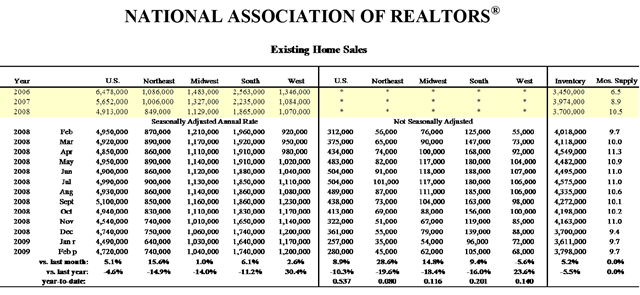
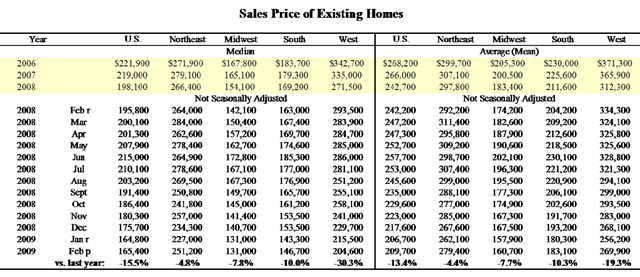
Now, putting just these two data points together, one would hazard a guess that a stabilization of home prices is not what this points to. What about housing inventory and also the prices of homes given the current conditions? You can get the data from the National Association of Realtors Statistics: Existing Home Sales and Sales prices of Existing Homes.


image

The inventory (in terms of months of supply of existing homes) is unchanged from 1 year ago and as we enter the season for home sales, we shall have to see how it goes.

image

However, what should be noted from the two tables above is that for virtually unchanged supply of homes, the average home prices have decreased 15.5% nationally. So what belies this sort of optimism? But Ian MacIntyre is talking about the crisis and not whether the residential real estate is about to improve. But what if this is but a temporary floor which soon gives way – wouldn’t the banks be back in the doghouse then? On a side note, perhaps, the best indicator of the fact (some time in the future) that the housing market has stabilized will be an onslaught of “How to get rich through foreclosures” schemes. I’m not trying to be funny here but honey to be had does bring bees.

So what does this have to do with the supply chain for crying out loud? Take a look at the consumer confidence which is at the lowest level since it was instituted as a measure.

image

The road to recovery looks like a long and winding one.


The shell game end game

0saves

We’re in the show your cards stage of the shell game that we’ve been playing for a while – the greater part of more than a decade. It feels like we’ve been played but that’s only because we’re not really the players – we’re the pawns in a high stakes game.

Consider one of the players – China. Now, note how the headlines changed in a matter of weeks:

Jan 8, 2009 – U.S. debt is losing its appeal in China

At first glance, the declining Chinese appetite for U.S. debt -apparent in a series of hints from Chinese policy makers over the past two weeks, with official statistics due for release in the next few days – comes at an inopportune time. On Tuesday, the U.S.president-elect, Barack Obama, said Americans should get used to the prospect of "trillion-dollar deficits for years to come" as he seeks to finance an $800 billion economic stimulus package.

Feb 11, 2009 – China to stick with US bonds

Mr Luo, speaking at the Global Association of Risk Management’s 10th Annual Risk Management Convention, said:

Exactly!!!

0saves

For what it

A glimmer of sense…

0saves

A glimmer of sense starts filtering through… Banks still tightening loan standards

The article suggests

Many banks have made it harder for borrowers to obtain all kinds of loans over the last three months despite a $700 billion federal bailout program and a flurry of other bold moves to stem the worst financial crisis to hit the country since the 1930s.

yet brimming within you had to have detected the hardly restrained despair over the perceived double cross – It reads, “They (banks) take our money and refuse to lend it out…”. Expect the nonsense to get a whole lot more shrill just as sense was beginning to take hold.

This vindicates the following: Sense is as delicate as nonsense is compelling.

As bankers return to the norm (after that last mania has died), the question that remains really is what is the norm for a politician? Draw that norm and you have made some distance in setting the expectation of how bad this mess is going to get. There is a plethora of danged and damned danged stuff out there that form the repertoire of a seasoned interventionist (You might appreciate that the US government, and every other government in the world as well, is in full interventionist mode) – Price controls, wage controls, nationalization, funky money, funkier money, generic stimulus, targeted stimulus, “Dang, I hope this works” stimulus, quotas, protectionism, tariffs, Buy American – (What is American anymore?), unemployment, adjusted unemployment, severely one time adjusted unemployment, “we just stopped counting” – unemployment, war, senseless wars, senseless wars made sensible… In short, there is nothing sensible when it comes to politicians or the government.

So what does that mean to the supply chain at large. I can think of two possible impacts immediately.

1. Increased pace (perhaps tending to the frenetic) of lobbying efforts – When the government enters the playing field (and as of now, it is hovering and peddling influence at the periphery) as I expect that it will, firms up and down the supply chain will have to expend considerable lobbying influence to either keep the playing field as is or towards favorable terms. Naturally, the firms with deep pockets will benefits immensely from this whereas the smaller players in the supply chain (be it services such as 3PLs or carriers or actual suppliers of raw materials or intermediary products) will lose out unless they get their collective pockets together. Of course, frantic money encircling government begets not efficiency of investment (perish the thought) but beggars scandal – expectation of many money scandals is now firmly on my screen.

2. Stimuli – Can anyone put forth the reasoning behind the stimulus? Why stimulate anything in the first place and why does the government have to do the stimulating? The second part first – only the government has the “magical ability” to create something out of nothing – in other words, when the government says, “Let there be money.” Poof!! “And there was money.” Let

Ponder this…

0saves

Something I ponder about as I survey the mess:

Strategic planning does not deal with future decisions. It deals with the futurity of present decisions. Decisions exist only in the present. The question that faces the strategic decision-maker is not what his organization should do tomorrow. It is,

What is Credit?

0saves

Or why the credit crunch of recent times and its solution(s) seem rather off base:

“There is a strange idea abroad, held by all monetary cranks, that credit is something a banker gives to a man. Credit, on the other hand,is something a man already has. He has it, perhaps, because he already has marketable assets of a greater cash value than the loan for which he is asking. Or he has it because his character and past record have earned it. He brings it into the bank with him. That is why the banker makes him the loan. The banker is not giving him something for nothing. He feels assured of repayment. He is merely exchanging a more liquid form of asset or credit for a less liquid form.”

Henry Hazlitt, Economics in One Lesson.

This is a fundamental issue of what Credit means – in so much as the lender of capital has something to give, the user of capital has also something to offer – this is a transaction of promises. Several aspects of our current situation follow a definition of credit apart from this fundamental transaction – in many aspects, our current situation can be ascribed to a focus on the mechanical aspects of credit transactions.

The solutions engaged in by the Fed also smacks of the same – printing out more money and asking (and when that fails, forcing) the banks to lend it. Lend it to whom? To those who need it (even to survive) or to those who have a track record of value creation? In so far as much, lending takes places or doesn

Charting through the snow…

0saves

It is that time of the year where we chart through the snow… No, we never do that. But these are extraordinary times. So I share a couple of charts with you minus the commentary. The lack of commentary is part amazement and part “What the heck does this mean going forward?” – I

About me

I live, work and blog from Newburgh, New York. I work for IBM as a senior consultant in the Fab PowerOps group that works around the issue of detailed Fab (semiconductor fab) level scheduling on a continual basis. My erstwhile company ILOG was recently acquired by IBM and so I've made the transition to the Websphere group.

@ SCM Clustrmap

Locations of visitors to this page

Subscribe by email

Enter email:
Delivered by FeedBurner

Enter email to subscribe


July 2010
S M T W T F S
« Jun    
 123
45678910
11121314151617
18192021222324
25262728293031

Archives